


A vein viewer purchase can be a small handheld buy or a larger capital spend, depending on the tech, the clinic, and the support plan behind it. For UK clinics, the real question is not only the upfront vein viewer cost, but whether the device supports vein assessment, fits the clinic’s workflow and provides sufficient value for its cost. UK clinics can buy professional vein viewers online, but should compare the technology, clinical suitability, regulatory information, support and total ownership cost before choosing a device.
This guide explains what drives price, how common vein imaging tools differ, and how to choose a vein finder device that fits your clinical use case without overspending.
How much does a vein finder cost in the UK?
In the UK, a clinical vein finder often ranges from a few hundred pounds for simple handheld or light-through devices to several thousand pounds for advanced near-IR projection systems. Public pricing is uneven because suppliers often quote by model, volume, warranty, add-ons, VAT, and service cover. For example, NICE's AccuVein AV400 overview listed an NHS buy price of £3,300 before VAT, while Veinlite's public device prices range from $249 to $689 before UK import, VAT, or dealer costs.
This spread is normal. A small aesthetics clinic that needs a device for finding veins before injections may not need the same system as an A&E unit, paediatric ward, vascular access team, or high-volume phlebotomy service. The best value usually comes from matching the tech to the patients you see most often, not from buying the priciest vein scanner by default.
What affects vein viewer cost?
The sticker price is only one part of the buy decision. A cheaper vein finder may look good at first, but if it is hard to clean, fragile, poorly supported, or not right for your patient group, it can cost more in daily use.
Key cost factors include:
- Tech type: near-IR systems, light-through devices, and basic consumer lights are priced differently because they use different optics, image processing, materials, and clinical designs.
- Medical device status and documentation: clinics should check whether the supplier can provide the right medical device docs, use instructions, compliance info, and infection-control guidance.
- Mobility: a pocket-sized or handheld device may cost less than a stand-mounted unit, but hands-free add-ons, chargers, mounts, and carry cases can lift the total.
- Depth and image clarity: more advanced systems may help you see deeper or less obvious vessels, though no vein scanner replaces palpation and clinical judgement.
- Add-ons and consumables: disposable covers, batteries, chargers, adapters, and protective cases should be part of your cost check.
- Warranty and service: longer cover, replacement plans, and fast tech support matter if the device will be shared across teams.
- Training time: a tool that is easy to learn can cut rollout friction, especially when many clinicians need to adopt it fast.
For buying teams, ask suppliers for the full delivered cost, not just the device-only price. That should include VAT, shipping, add-ons, first-month consumables, warranty terms, and what happens if the unit fails.
The main vein finder tech explained
Most clinic buyers compare two broad groups: near-IR vein imaging and light-through tools. Both can help, but they work in different ways and suit different jobs.
Near-IR vein scanners
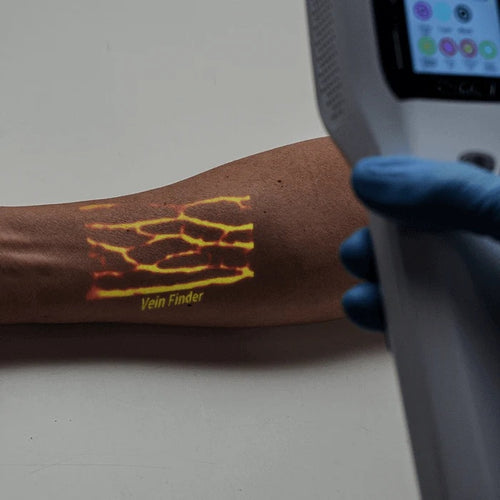
A near-IR vein scanner uses light that reacts differently with blood and tissue, then shows a vessel map on a screen or on the skin. Systems such as AccuVein and VeinViewer-style tools are often linked to this group, and they are commonly sold for cannulation support, phlebotomy, and hard venous access.
The upside is that clinicians can see a vein map without pressing on the site. That can help with route planning, anatomy teaching, or finding superficial veins that are not easy to see. The trade-off is that higher-end projection systems often cost more, and some need setup, charging, calibration, or more careful handling.
Transillumination vein finders
Transillumination devices shine light through tissue so that veins appear as darker areas against the illuminated surrounding tissue. Veinlite, for example, says its devices use side-lighting and also focus on steady vein hold during access; its public comparison materials report first-stick success data for Veinlite devices and list models for paediatric, neonatal, emergency, clinical, research, and sclerotherapy use.
This group can suit clinics that want a compact, lower-cost device with simple setup and minimal workflow disruption. It may be useful when rolling veins, small veins, or repeated cannulation attempts are part of daily work. As with any clinical tool, claims should be checked against the exact model, the intended use, the evidence, and your own setting.
Which vein finder tech is best for your clinic?
The best vein finder is the one that improves the procedures your team does most often. A cosmetic clinic, paediatric service, emergency team, dental sedation provider, and vascular access service may all use vein imaging in different ways, so the right choice depends on use case, patient mix, cleaning needs, and budget.
Use this practical matching guide:
- For hospitals and urgent care: Look for portability, battery life, durability, straightforward cleaning and easy handover between clinicians. High-volume teams should also consider service cover, training and replacement options.
- For phlebotomy clinics: Choose a device that supports routine vein assessment without introducing unnecessary steps. Consistent imaging, infection-control requirements and hands-free operation may be particularly important.
- For aesthetics and sclerotherapy: Image clarity, superficial vein mapping and straightforward positioning are important. The device should support treatment planning without replacing clinical judgement, particularly around higher-risk treatment areas.
- For paediatric, neonatal and community care: Consider device weight, rapid setup, portability and suitability for smaller or more fragile patients. Mobile teams should also account for charging, protective storage and available mounting options.
Where possible, trial the device with the clinicians and patient groups for whom difficult venous access is most commonly encountered.
How does the Medical Store Vein Finder compare with AccuVein?
AccuVein is one of the best-known names in near-infrared vein visualisation. Both the AccuVein AV500 and our professional Vein Finder project a real-time image of superficial veins onto the patient’s skin, but they differ in price, technology, display options and proprietary features.
The Medical Store professional infrared Vein Finder starts from £1,450, with flexible table stand and mobile trolley configurations also available.
According to the manufacturer’s specifications, our device offers:
- Dual 850nm near-infrared light sources
- Non-laser, non-contact vein visualisation
- Real-time imaging at more than 30 frames per second
- Seven single-colour and four dual-colour display modes
- Normal, inverse and enhancement viewing modes
- Three projection sizes and adjustable brightness
- Approximately six hours of battery operation
- An optimal projection distance of 26 ± 2cm
- An approximate device weight of 400g
- Adult and paediatric applications, with a stated maximum vein detection depth of 10mm
- Handheld, flexible table stand and mobile trolley configurations
The multiple projection colours, brightness levels and image sizes allow clinicians to adjust the display for different patients and working environments. The device’s Class IIa product category is also recorded as registered in the MHRA Public Access Registration Database under GMDN code 47604 – Liquid crystal vein locator. MHRA registration does not represent MHRA approval or endorsement.
The AccuVein AV500 uses a Class 1 near-infrared laser to project a real-time green image of superficial veins. It weighs approximately 283g and includes proprietary True Center technology, factory-set alignment, three brightness settings and an inverse display mode. Optional hands-free mounting systems are also available.
AccuVein does not publish a current UK price for the AV500, so clinics generally need to request a quotation. For historical context, NICE reported an NHS acquisition cost of £3,300 excluding VAT for the older AccuVein AV400 in 2014. This should not be interpreted as the current AV500 price.
Which provides better value?
The AccuVein AV500 is lighter and benefits from an established specialist brand, proprietary alignment technology and extensive supporting resources.
However, our Vein Finder provides real-time near-infrared projection, considerably more colour choices, multiple viewing modes, approximately six hours of battery operation and flexible hands-free configurations from a clearly published starting price of £1,450.
For clinics focused on practical features and purchase cost, the Medical Store Vein Finder offers a strong-value professional alternative without requiring the premium investment historically associated with AccuVein systems.
The two devices should not be assumed to provide identical clinical performance, as no direct head-to-head study between these particular models has been identified. Clinics should base their decision on intended use, training, support, documentation and procurement requirements as well as price.
Clinical benefits to look for beyond price
A vein finder device should not be treated as a gadget. Its value comes from helping clinicians make better calls before the needle goes in: where to try access, which veins to avoid, when to escalate, and whether another method such as ultrasound is more suitable.
The benefits clinics often look for include fewer repeat attempts, better patient confidence, less bruising, faster flow, and steadier support for hard venous access. Evidence varies by device and study design, so buying teams should ask for model-specific data rather than broad claims. NICE's AccuVein overview, for example, noted that evidence reviewed for the AV400 was based on studies of the older AV300 rather than AV400-specific studies.
It is also worth being realistic. A vein scanner can help you see vessels, but it does not replace anatomy knowledge, touch, safe needling, escalation rules, or ultrasound when deeper vascular access is needed. The best results usually come when the device is part of a clear clinic flow rather than just an extra tool.
A practical buying checklist for UK clinics
Before you ask for quotes, define what good value means for your service. A clinic that performs a few procedures a week may have a very different threshold from a busy hospital department.
Use this checklist during evaluation:
- Define the clinical requirement. Are you trying to support difficult cannulation, assess superficial veins, assist training or improve procedure workflow?
- Identify your patient groups. Consider children, older people, darker skin tones, bariatric patients, dehydrated patients and those with a history of difficult venous access.
- Compare the total cost. Include VAT, delivery, mounts, chargers, protective storage, warranty cover and any servicing requirements—not only the initial device price.
- Review the evidence and trial the device. Ask for model-specific documentation and, where possible, test the device with your clinicians, patients, lighting and treatment environment.
- Check cleaning, training and workflow requirements. Establish how the device will be cleaned, stored, charged and incorporated into existing clinical procedures.
- Confirm support and warranty arrangements. Check repair turnaround times, replacement options, servicing and responsibility for return shipping.
This process helps clinics choose a device that works reliably in everyday practice, rather than basing the decision only on price or a supplier demonstration.
A professional option for UK clinics
Medical Store supplies a professional near-infrared vein finder for clinics, hospitals, phlebotomy teams, aesthetics providers and community healthcare settings.
Starting from £1,450, the device combines real-time projection with approximately six hours of battery life, multiple viewing modes and a choice of handheld or hands-free configurations.
View the Medical Store Vein Finder and available mounting options.
Final takeaway
A UK clinic can expect vein finder prices to range from hundreds to several thousands of pounds, depending on tech, support, add-ons, and medical grade. The most cost-effective choice is not always the cheapest or the most advanced; it is the vein finder that fits your patient group, improves flow, and is easy for your team to use well.
Before you buy, compare total ownership cost, ask for model-specific evidence, and trial the device in real clinic conditions. A well-chosen vein viewer purchase can support calmer appointments, more confident clinicians, and a smoother experience for patients who are hard to cannulate.
Q&A
Question: What should clinics include when comparing vein finder prices?
Short answer: Clinics should compare total ownership cost, not just the device-only price. That means VAT, delivery, add-ons, disposable covers, batteries, chargers, mounts, protective cases, staff training time, warranty terms, servicing, and loan-unit or replacement plans if the device fails.
Question: How do near-infrared and transillumination vein finders differ?
Short answer: Near-infrared vein scanners use the interaction between near-infrared light, blood and surrounding tissue to generate or project a map of superficial veins. Transillumination devices shine light through tissue so veins appear as darker areas. The technologies operate differently and may suit different clinical applications and budgets.
Question: Can a vein finder replace palpation, clinical judgment, or ultrasound?
Short answer: No. A vein finder can support vein view and access planning, but it does not replace anatomy knowledge, touch, safe needling, escalation rules, or ultrasound guidance when deeper vascular access is needed. It works best in a set clinical flow.